

At times elegant and captivating, Jeffrey St. Jules’ The Silent Planet is a standout in lo-fi science fiction. The film is crafted with an incredible level of detail, from the two particularly strong performances to the technical work, and the overarching plot showcases the fragility of our minds in such environments. The second act tries to think for us, but the rest of the film makes it an enjoyable watch.
Theodore (Elias Koteas) is a terminally ill convict serving a life sentence alone on a silent planet. With every passing day, his memories of Earth Earth become foggier. When a new prisoner, Niyya (Briana Middleton), arrives, he is excited to have a companion. Still, she wants to be left alone. His persistence eventually wins her over until a foggy memory returns to him with dire consequences.
Despite the setting, writer/director Jeffrey St. Jules takes a unique psychological approach with his film. He delves into the ramifications of humans being left in such a solitude-filled void, raising thought-provoking questions about coping with trauma in a place that amplifies inner voices.
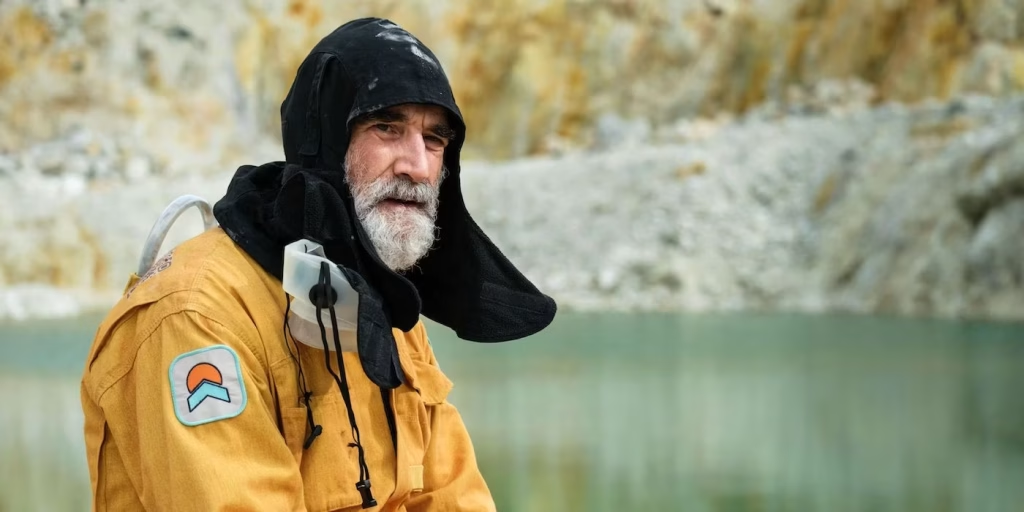
St. Jules revels in playing and enquiring with reality and illusion on his characters as time progresses. The inclusion of a purple thought-recording cloud of gas that moves between the two is a wonderful touch. It adds another layer to the paranoia that not only does one have when they spend too much time in their head, but when they think the worst of what someone else may be thinking. This paranoia, with Niyya adamant that Theodore is the person who caused her anguish when they were both on Earth, is not just engaging, but it also serves as a powerful exploration of the human mind under extreme isolation and stress.
The Silent Planet’s lo-fi aesthetic is perfect for the sparse tone that Jeffrey St. Jules is aiming for. Credit needs to go to Production Designer Andrew Berry, who has created an interesting environment in which our characters can live. Partially giving vibes of Tony Noble’s work on Moon, the clean, minimalist, but practical look really pulls you into Theodore and Niyya’s world. Even ensuring that due to Theodore’s mental and physical decline, his home is a bit more run down, just dirty enough to feel lived in for decades without being kept in good condition. Like Theodore himself and eventually Niyya, left to get by and nothing more. It is top-notch work that allows us to focus on the characters and their increasing paranoia about each other.
Elias Koteas and Brianna Middleton shine in their performances in St. Jules’s film. Koteas is committed as you can get to the increasingly crumbling Theodore. In contrast, Middleton has to be the polar opposite, at least at the start of The Silent Planet. She has to show a level of resilience and strength that wasn’t previously seen thus far in the film. But, because of the level of her trauma, she soon cracks, too. They are both fully committed to their roles, and all you can do is feel pity for them being stuck in this position, even if it was by their choice.

St. Jules’ choice to opt for Newfoundland as the set piece for The Silent Planet is an inspired choice. The vast emptiness of the landscape really cements the idea of how alone these two people are and how Theodore coped on the planet alone, so desperately alone for so long hits you thanks to Director of Photography Paul Sarossy’s gorgeous work. Often opting for aerial shots when our characters are outside, you grasp their solitude, only for the camera to be stuck close to each character and even more so when both Theodore and Niyya are in the same room together. He has the characters, especially Niyya, who feel suffocated by Theodore being there, unable to have a second of the piece. It’s smart work in a film that, from a technical standpoint, is as close to flawless as you can get.
While you can tell that The Silent Planet is meant to challenge its audience, it struggles to be as subtle as it wants. Things are spelt out too much to allow audiences to embrace the story fully. We are immersed, yes, but never enraptured. We need to be for the film to be as effective as it tries to be. At times, it should allow us to put one and one together. Instead, it needlessly does the homework for us, which is a shame as it is so close to being a fantastic science-fiction film.
It’s a slight known on what is still an excellently made film. That opening act of Koteas struggling through the world on his own works so well. Equally, the slow turn to a thriller is exciting, yet how it gets to those two points doesn’t fully connect as you want it to. Regardless, this is a film that you need to source when it becomes available to you, as, without a doubt, you will be able to take something from it.
★★★ 1/2
For more of our coverage of Fantasia Festival 2024 please check out our reviews below:
Support Us
I am but a small website in this big wide world. As much as I would love to make this website a big and wonderful entity, that would bring in more costs. So, for now, all I hope is to make Upcoming On Screen self-sufficient—well enough that any website fees are less of a worry for me in the future. You can support the website below…
Patreon
You can support us in a variety of ways (other than that wonderful word of mouth and those lovely follows). If you are so inclined to help out, you can support us via Patreon; find our link here! We don’t want to ask much from you, so for now, we have limited our tiers to £1.50 and £3.50. These will, of course, grow the more we plan to do here at Upcoming On Screen.
Buy Us A Coffee
Our other method is through the wonderful Buy Us a Coffee feature, but seeing as we are not the biggest fans of coffee, a pizza will do! We keep it fairly small change on that as well, and it allows you to give just a one-off payment, so there’s no need to worry about that monthly malarky! We even have a little icon on the website for you to find it and help us out with the running of the website.
Social Media
You can also support us via Twitter and Facebook by following us and liking us. Every single one helps!


